Unified Treatment Journal, Exercise Log & Bluetooth Scanner
Treatments, vaccinations, castrations, and hoof trimming now all appear in a single journal. Plus: the new RAUS/BTS exercise log, fast scanning via Bluetooth reader, and a cleanly separated castration data model.
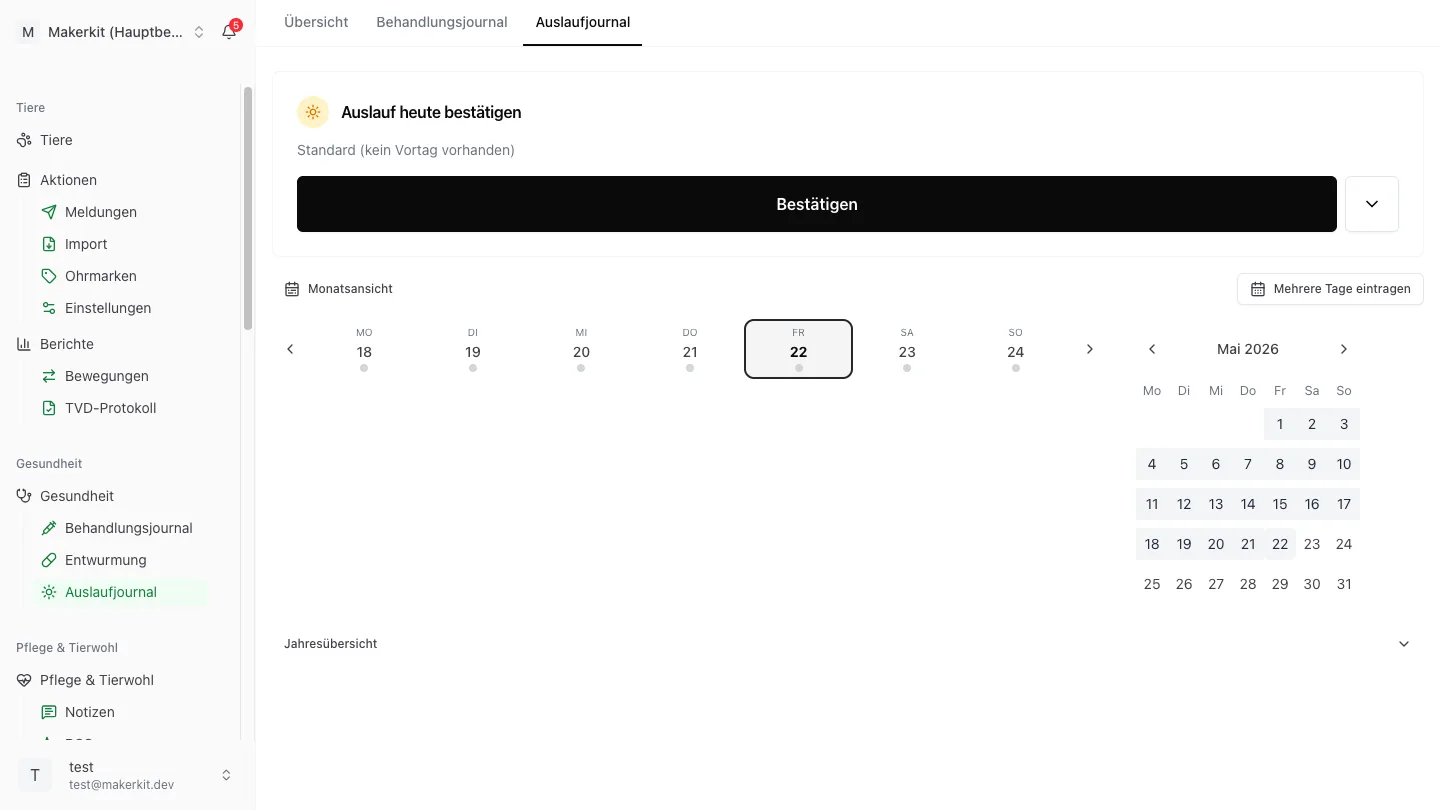
This update bundles four major improvements that all share the same goal: fewer clicks in the daily barn routine, more clarity in documentation.
Unified Treatment Journal
The previously separate Treatments and Health Events sections have been merged into a single treatment journal.
- One form for all entry types — choose medication treatment, vaccination, castration, or hoof trimming using the type selector at the top of the form.
- One list, one animal history — all entries appear chronologically in the treatment journal and in the "Health" tab of every animal profile.
- One batch page — start a group treatment, group vaccination, or a series of hoof-trimming sessions from the same workflow.
- The former "Events" tab is removed. Existing entries have been migrated.
Exercise Log (RAUS/BTS Compliance)
For farms receiving RAUS or BTS contributions, there is now a complete exercise log.
- Record exercise days per group or animal — with category (pasture, exercise yard, no exercise due to weather, etc.) and notes.
- Multiple animals at once — batch entry for entire groups per day.
- Alpine summering is automatically included — animals on the alpine pasture automatically appear with grazing days; no double entry needed.
- Export as PDF and CSV for the annual direct payments settlement.
Bluetooth Ear Tag Scanner
Anyone working with a Bluetooth reading pen (e.g. standard RFID pens) now benefits from global scan capture.
- Scan on any page — the scanned code is recognised on every Herdy page; input fields are filled automatically.
- Audio feedback — a short confirmation tone signals a successful scan.
- Toast notification shows the most recently captured ear tag number with actions (open animal / continue with next action).
- Manual keyboard entry continues to work without restriction — the scanner is an addition, not a requirement.
Castration Date Separated from Sex
Previously, sex and castration status were in the same field. These are now separated — with clear benefits for breeding and analysis.
- Sex remains fixed (male/female) — unchanged after castration.
- Castration status as its own field with an optional castration date.
- Imported from TVD — wethers, castrated males, and castrated bucks are automatically detected during synchronisation and marked accordingly.
- Existing animals were automatically and correctly separated during migration.
Tip: When you have animals castrated, record the castration as an entry in the treatment journal (type "Castration") — this documents both the fact and the date.