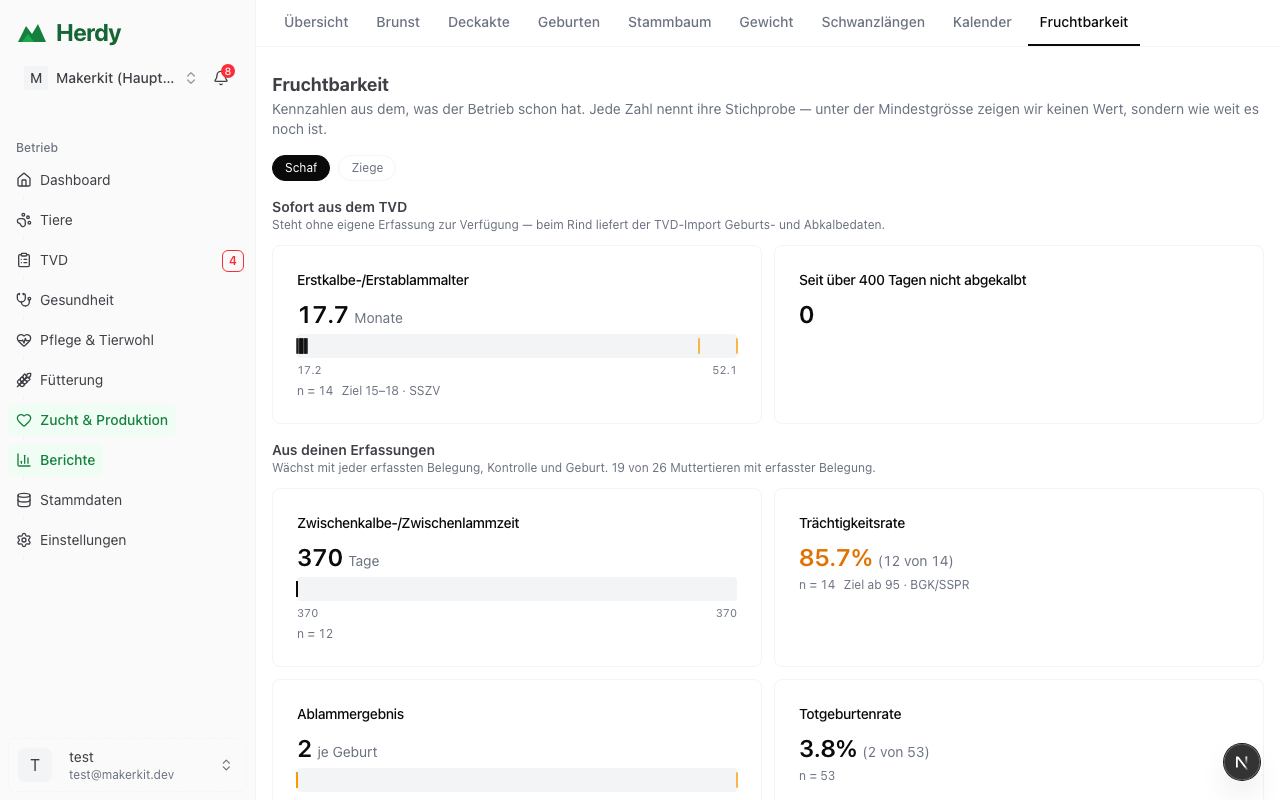
Under Breeding → Fertility you find your herd's key figures. The page follows two rules that set it apart from many other analyses: every figure names its sample, and where the sample is too small, no number is shown.
Why a figure is sometimes missing
An average over two animals is not a key figure, it is chance. So Herdy only shows a value from a minimum count:
- Distributions (age at first calving, calving interval, offspring per birth) from 5 values
- Rates (pregnancy rate, stillbirth rate) from 10 animals
Below that it reads "Not enough data yet (3 of 10)" -- so you can see how far off it is. That is more honest than a number you cannot trust.
Implausible values
A "calving interval" of 30 days is not biology, it is a duplicated birth record. Such values do not enter the average -- but they do not vanish silently either: they appear as "n implausible" next to the figure. That is your cue to check the records.
The two blocks
Straight from the TVD
These numbers are available without any data entry of your own, because they come from the TVD data -- for cattle the import supplies birth and calving dates:
- Age at first calving -- how old your cows were at their first calving
- No calving for over 400 days -- a list, not a number. A click takes you to the animal.
Worth knowing: the calving interval is not in this block. The TVD supplies the first and last calving, but not how many there were in between -- no interval can be derived from that. This figure fills up once you have recorded two births of the same animal.
From your own records
Grows with every recorded mating, check and birth. At the top you see the coverage, e.g. "19 of 26 dams have a recorded mating" -- so you can judge how much of your herd the figures rest on.
- Calving / lambing interval
- Pregnancy rate
- Offspring per birth
- Stillbirth rate
- Pregnancy rate per sire
Pregnancy rate per sire
This figure deserves particular attention. According to BGK/SSPR only 70--80 % of sires are genuinely ready at the start of the season, and one sire carries up to 50 ewes. An empty sire therefore costs a whole season -- and nothing else in the herd data reveals him.
If something like "4/10" appears instead of a percentage, it means: animals are still missing for a reliable rate.
Reference values
Reference bands with their source sit next to the figures. If your value falls outside, it is highlighted.
| Figure | Species | Reference | Source |
|---|---|---|---|
| Age at first calving | Cattle | 24--30 months | Mutterkuh Schweiz |
| Age at first lambing | Sheep | 15--18 months | SSZV |
| Age at first kidding | Goat | 12--15 months | FiBL |
| Calving interval | Cattle | up to 400 days | Swissgenetics |
| Pregnancy rate | Sheep, goat | from 95 % | BGK/SSPR |
| Offspring per birth | Sheep, goat | 1.5--1.8 | BGK/SSPR |
Where no documented Swiss reference exists, Herdy deliberately shows none -- a guessed number would be worse than nothing.
Gestation lengths on file
Herdy calculates the due date from these values. For cattle it does so per breed, because the differences run to nine days -- a blanket figure would be regularly wrong on a Limousin farm.
Cattle, by breed
| Breed | Gestation |
|---|---|
| Jersey | 281 days |
| Angus | 281 days |
| Holstein | 282 days |
| Red Holstein | 284 days |
| Eringer | 284 days |
| Swiss Fleckvieh | 286 days |
| Braunvieh / Brown Swiss | 290 days |
| Original Braunvieh | 290 days |
| Limousin | 290 days |
| Simmental / Fleckvieh | 290 days |
| All other breeds | 285 days |
Other species
| Species | Gestation |
|---|---|
| Sheep | 147 days |
| Goat | 150 days |
| Pig | 115 days |
For pigs that matches the rule of thumb "3 months, 3 weeks, 3 days".
Your own value per mating
If an animal deviates regularly, you can enter your own gestation length in the mating form under Advanced options (100 to 320 days). That value takes precedence over breed and species.
Cycle parameters per species
These values drive when Herdy proposes heat and check dates. They can be adjusted per species under Breeding → Settings.
| Parameter | Cattle | Sheep | Goat | Pig |
|---|---|---|---|---|
| Cycle length | 21 days | 17 days | 20 days | 21 days |
| Return-heat checks | 2 cycles | 2 cycles | 2 cycles | 2 cycles |
| Pregnancy check after | 35 days | 40 days | 40 days | -- |
| Re-check after an unclear result | 14 days | 14 days | 14 days | 14 days |
| Heat check after birth | 21 days | -- | -- | -- |
| Breeding-age watch | 15 months | 10 months | 7 months | 7 months |
| Breeding season | all year | Sep--Dec | Sep--Dec | all year |
The values come from Swiss association sources: Mutterkuh Schweiz and Swissgenetics for cattle, BGK/SSPR and SSZV for sheep and goats, SUISAG for pigs, FiBL for goats.
Pigs: no pregnancy-check date is held for pigs yet -- the return-heat check already covers the early window. We are clarifying with the swine health service whether an additional date is useful, and will only add it with a documented source.