Overview
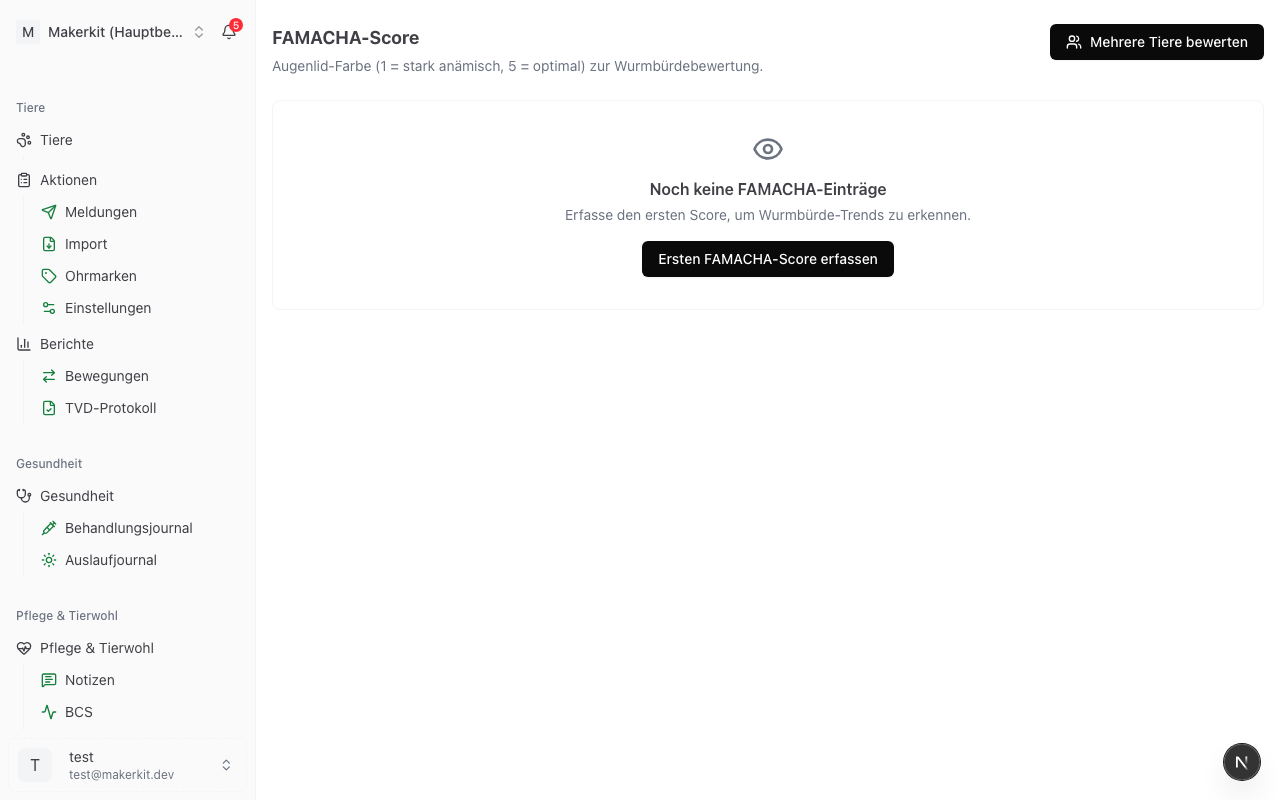
FAMACHA is an established rapid method for detecting anaemia -- most commonly caused by the gastrointestinal parasite Haemonchus contortus. Instead of routinely deworming the entire herd, you treat only the animals whose eye mucous membranes are pale.
This saves active ingredient, protects effective products from resistance, and is an organic-compliant practice.
Note: The FAMACHA module is automatically hidden on pure cattle farms.
The FAMACHA scale
The scale assesses the colour of the lower eye mucous membrane on a scale of 1 to 5:
| Value | Colour | Meaning |
|---|---|---|
| 1 | Deep red | Optimal -- no intervention needed |
| 2 | Pink-red | Good -- continue monitoring |
| 3 | Pink | Borderline -- monitor closely |
| 4 | Light pink / pale | Treatment recommended |
| 5 | White | Treat urgently, contact veterinarian |
Recording a FAMACHA value
How to record an assessment for a single animal:
- Open the animal profile
- Switch to the FAMACHA tab
- Tap New assessment
- Tap the appropriate colour dot (1--5)
- Enter the date (default: today)
- Optional: Note (e.g. "Animal appears lethargic")
- Tap Save
Batch recording per group
When doing a check of the herd, use batch recording:
- Go to Care > FAMACHA
- Tap New batch recording
- Select the animals (individual or entire group)
- For each animal:
- Tap the appropriate colour dot
- Next animal via scan, search, or "Next" button
- Tap Save session at the end
Animal timeline and trends
In the FAMACHA tab in the animal profile you see:
- The last assessments with date and colour
- The progression over time
- A link to dewormings from the treatment journal -- so you can see whether a treatment improved the score
Group overview
On the FAMACHA overview page you see:
- Current distribution -- how many animals are in which colour category
- Treatment recommendation -- all animals with score 4 or 5
- Trend -- the average per group over the last months
Tip: From an animal with score 4 or 5, you can directly record a deworming treatment in the treatment journal. The FAMACHA assessment remains stored in the health record as the reason.
Seasonal guidance
FAMACHA values change seasonally -- typically:
- Spring -- first increases with the start of grazing
- Late summer -- peak, often critical in wet weather
- Autumn / winter -- values usually drop again
Weekly to fortnightly monitoring during the main grazing season is standard practice.
Scientific background
The FAMACHA method was developed at the University of Pretoria and is today the gold standard for selective deworming. It is recommended by the Swiss veterinary profession and is compatible with the requirements of Bio Suisse and IP-Suisse.