Overview
The Body Condition Score (BCS) is an established method for objectively assessing the body condition of your animals. Instead of going by feel ("looks thin"), you work with a scale from 1.0 to 5.0 in half-point increments -- allowing you to compare animals with each other and track the development of each animal over time.
The scale ranges from 1.0 (emaciated) to 5.0 (obese) in 0.5 steps (1.0, 1.5, 2.0, ..., 5.0). The healthy range is typically between 2.5 and 4.0, depending on species and production stage.
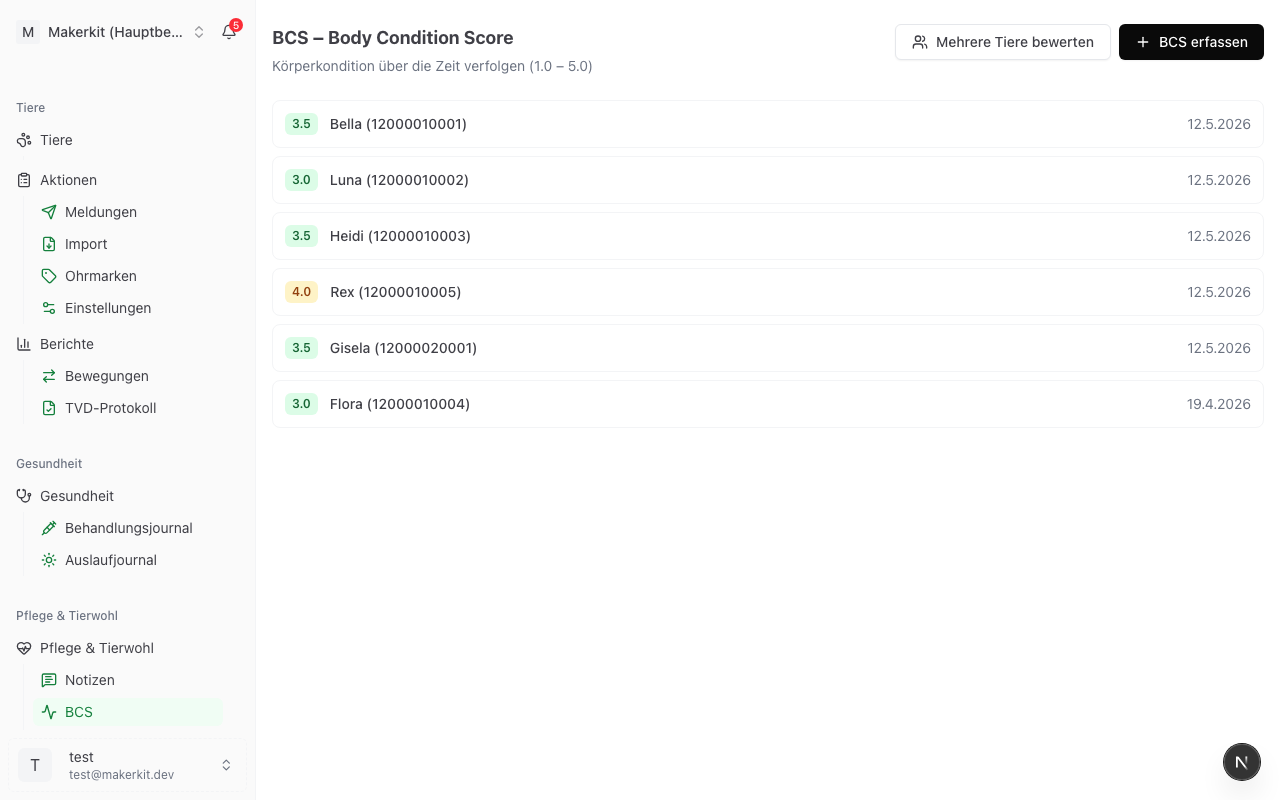
Recording BCS for a single animal
- Open the animal profile of the relevant animal
- Switch to the BCS tab
- Tap New assessment
- Select the appropriate score by tapping one of the 9 chips (1.0, 1.5, 2.0, 2.5, 3.0, 3.5, 4.0, 4.5, 5.0)
- Enter the assessment date (default: today)
- Optional: Note for special observations
- Tap Save
The assessment immediately appears in the animal timeline, and the trend chart is updated.
Tip: Record BCS regularly -- e.g. once a month for ewes, or at key moments (mating, lambing, weaning, shearing).
BCS batch recording per group
When you assess an entire group -- typically during a check after driving animals up or down -- use the batch recording:
- Go to Care > BCS
- Tap New batch recording
- Select the animals to be assessed:
- Select individual animals, or
- Select an existing group
- For each animal in turn:
- Tap the chip with the appropriate score
- Tap Next or scan the next ear tag
- Tap Save session at the end
Each assessment is saved as a separate entry per animal, all with the same date.
Understanding the trend chart
In the BCS tab in the animal profile you see the trend chart:
- Points -- each assessment with date
- Line -- the progression over time
- Green shaded band -- the healthy value range (typically 2.5 to 4.0)
This lets you immediately identify:
- Animals falling below the healthy range (e.g. after lambing)
- Animals rising above the range (e.g. too high a condition before the mating season)
- Gradual trends that are easily overlooked in day-to-day work
BCS in the group overview
On the care overview and on each group detail page you can see the average BCS of the most recently recorded assessments per animal. This allows you to identify groups that are on average slipping out of the healthy range.
When to record
Useful times for BCS recording:
- Before the mating season -- ewes should be in the lower third of the healthy range
- After lambing / birth -- measure the condition drop
- At weaning -- assess the recovery trajectory
- Before alpine drive-up -- animals must be fit enough
- After alpine drive-down -- assess any losses
- Before and after shearing (for sheep) -- the dense fleece can be misleading
Tip: BCS is a tool for multiple measurements over time. A single value is less meaningful than the progression over several months.