Overview
Since 1 October 2024 every sheep holding in Switzerland takes part in the national footrot control programme (Animal Diseases Ordinance, TSV Art. 228 to 229i). Each holding is sampled once between 1 October and 31 March; a positive result leads to quarantine and remediation.
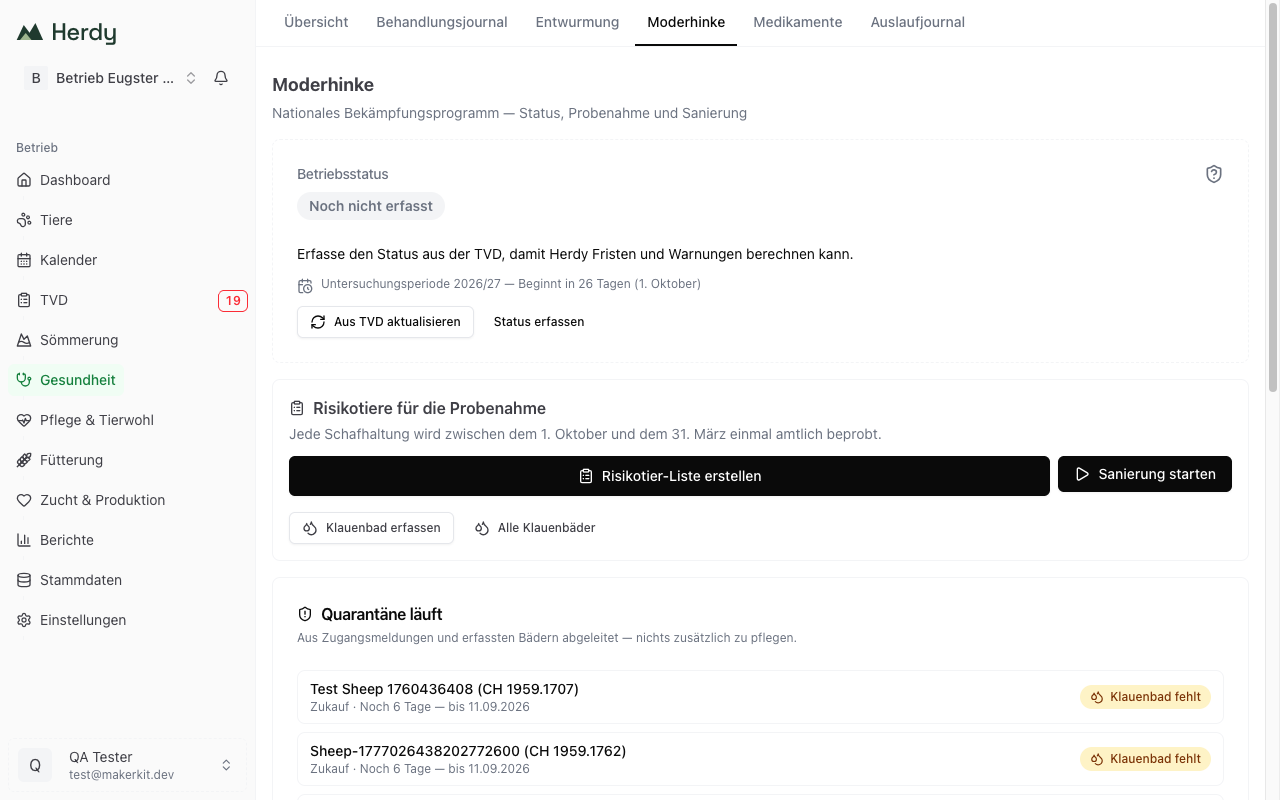
The Footrot tab guides you through that programme: it records the holding status, builds the risk-animal list for sampling, logs the hoof baths and works out when the retest becomes possible.
Requirements
- The tab is hidden on farms that keep no sheep.
- Refresh from TVD needs a TVD number on your holding and a connected TVD.
What Herdy is not: Herdy reports nothing to the veterinary office and issues no status. The examination is carried out by the sampler, and the status is issued by the authority. Herdy displays it and calculates with it.
Holding status
The top card shows your current status and what it means:
| Status | What applies |
|---|---|
| Free | Trade only with holdings that are also free. Buying from an untested flock costs you the status. |
| Not tested | Free holdings may not buy from you. Without a result by the end of the examination period the holding is blocked. |
| Blocked | Simple first-degree quarantine: no buying, no selling, no movement except direct to slaughter with the pink accompanying document. No alpine grazing. |
| Not recorded yet | Herdy does not know your status and cannot calculate deadlines. |
Below it stands the current or next examination period with the days remaining until 31 March, or until 1 October.
Taking over the status
Two ways are open:
- Refresh from TVD fetches the status straight from the livestock traffic database. That is the easier and the more reliable route.
- Record status enters it by hand. Pick the status, the date of the finding and, if useful, a note.
The card always shows where the value came from («From TVD» or «Entered manually») and when it was last checked.
If TVD reports no status, or a value Herdy does not recognise, the stored value is kept. Herdy never overwrites with a doubtful case.
Risk-animal list for sampling
Sampling is risk-based. The BLV sets the order, and the sampler does not know your flock: you do. Rather than reconstructing on the morning of the appointment which ewe was lame in July, let Herdy build the list.
- Tap Build sampling list
- Herdy shows how many animals are to be sampled and how many pools that makes
- Tap Print list and take the sheet to the barn
How many animals
The sample size follows the flock size including lambs:
- up to 20 sheep: every animal
- 21 to 30 sheep: 20 animals
- more than 30 sheep: 30 animals
Which animals, and in what order
Herdy ranks the animals in the order the BLV prescribes and names the reason for each one:
- Lame: clinical finding or foot rot at the last hoof trim
- Bought in: from the arrival notification in TVD
- Show: added by hand, because markets and shows leave no trace in the data
- Ram: uncastrated male
- Poor hooves: abnormal finding at the last hoof trim
- Random: picked at random across all age groups
A pool holds at most ten swabs, and the risk animals belong in pool 1 wherever possible. Herdy therefore splits the list into pools right away. Below the selection sits a reserve in case an animal cannot be caught.
Important: samples are taken before hoof trimming and before the bath, not after.
Recording hoof baths
The bath log is the document the cantonal remediation check asks for. Wrong dosing is one of the most frequent findings, and a dated log with product and concentration is the answer to it.
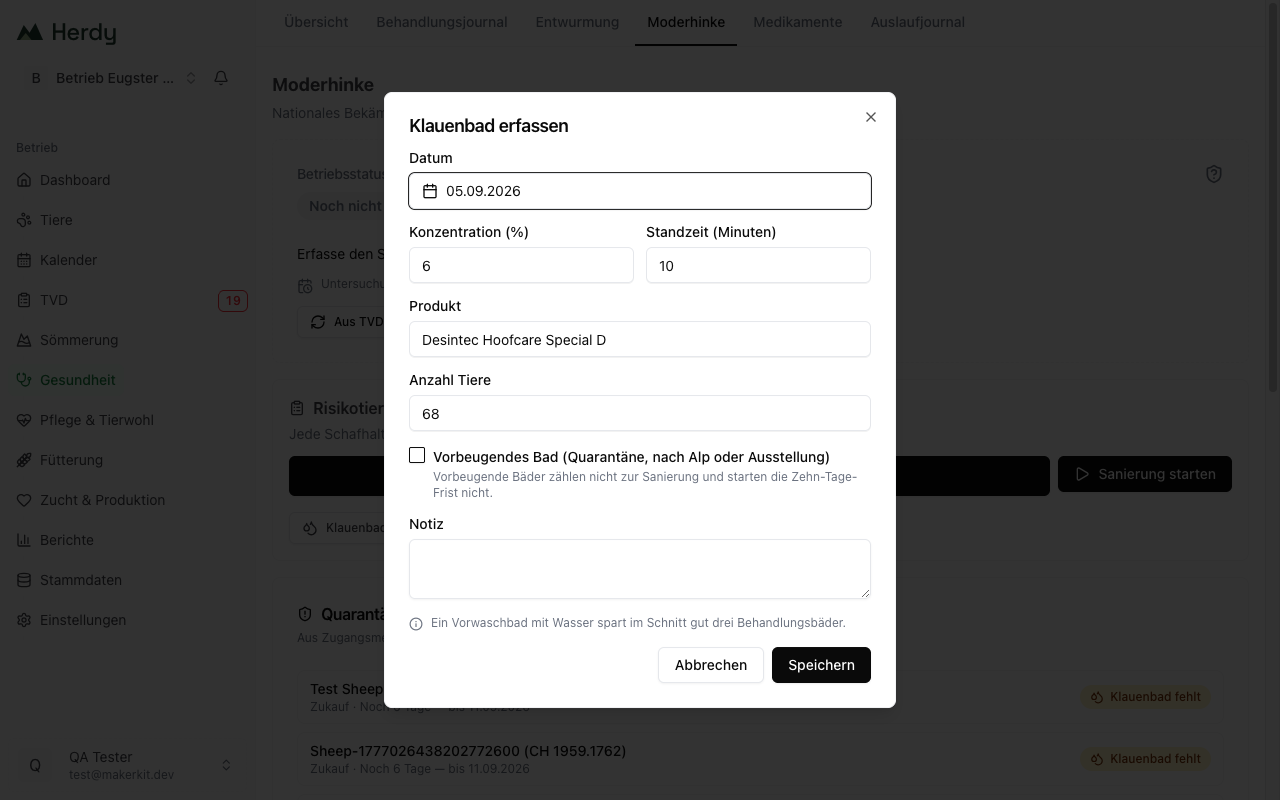
- Tap Record hoof bath
- Check Date, Concentration (%), Standing time (minutes) and Product. Herdy suggests the values of the approved protocol.
- Enter the number of animals, pre-filled with your flock of sheep and goats
- Tick Preventive bath if the bath belongs to a quarantine or followed alpine grazing or a show. Preventive baths do not count towards the remediation and do not start the ten-day clock before the retest.
- Save
All hoof baths shows the full log and lets you delete individual entries.
Tip: a plain water pre-wash saves about three treatment baths on average.
Remediation
If the result is positive, start the remediation in Herdy.
- Tap Start remediation
- Enter the start of remediation and the date of the positive finding. The second date, together with the last hoof bath, determines when the retest becomes possible.
- Save
From then on the tab shows a cockpit with two numbers and two buttons:
- Hoof baths: «Bath 7 of ~12» with a progress bar. Twelve is an experience value for roughly six weeks at two baths per week, not a requirement.
- Retest: the earliest date on which you can book the official retest
Below it you start another hoof bath or a hoof check.
When the retest becomes possible
Herdy works with two deadlines, and the later one applies:
- no earlier than 10 days after the last hoof bath
- no earlier than 3 weeks after the last positive finding
Booking too early extends the quarantine and costs money: the canton pays for the sampling of the initial examination and the first follow-up; from the second follow-up you pay the laboratory costs yourself.
Rule of thumb from practice: once every hoof on every animal has healed, do two more baths before booking. Flocks still showing symptoms should not be sampled at all.
Hoof check
Start hoof check takes you through the flock animal by animal, giving each one a footrot stage from 0 to 5:
| Stage | Finding |
|---|---|
| 0 | Healthy hooves |
| 1 | Moist, reddened skin |
| 2 | Inflamed skin, horn damaged |
| 3 | Inner wall detaching |
| 4 | Detachment across sole to outer wall |
| 5 | Horn capsule shed |
From stage 2 an animal counts as clinically affected. The rounds build the Remediation progress curve: the share of animals with no finding per check round.
Animals not responding
From the checks Herdy derives a list of Animals not responding, in three levels:
- Watch: no improvement after four baths
- Consider culling: no improvement after eight baths
- Urgent: still clinically affected after twelve weeks
This is a recommendation, not a rule. Individual veterinary treatment is the alternative to culling, and the decision stays with you.
Closing the remediation
Once the retest is negative, tap Close remediation, enter the closing date and pick «Retest negative» as the outcome. If the remediation was abandoned, pick «Aborted».
Remediation report
Remediation report produces the document for the cantonal check:
- As PDF: a summary with holding status, start of remediation, last positive finding, number of baths and retest date, plus tables of hoof baths, hoof checks and animals not responding
- Hoof baths as CSV: for further processing
The report is available as soon as there is a running or completed remediation, or at least one recorded bath.
Quarantine
The Quarantine running card builds itself from your arrival notifications and the recorded baths. It shows animals that were bought in or returned from the alp, with the days remaining and the note Hoof bath recorded or Hoof bath missing.
The period is four weeks, because the pathogen survives at most that long away from a hoof. You do not have to maintain anything extra.
Biosecurity
At the foot of the page stand the rules that make a remediation hold. Reinfection is the most common reason a remediation fails:
- Do not buy from unremediated flocks, check the source holding's status in TVD
- After markets, shows and alpine grazing: hoof bath and quarantine
- Use only pastures that have held no sheep for at least four weeks
- Start trimming with sound animals, disinfect tools between animals, horn into the waste bin
- Include goats in the same holding in trimming, bathing and checks
- Clean and disinfect transport vehicles after every use
Checking a partner farm's status
Before buying, it is worth a look at the source holding: an animal from an untested flock costs you your own «free» status.
- Add the holding once under Master data > Partner farms with its TVD number and the category «Farm», see Partner Farms
- Open it in the list; the detail page shows the card Footrot status at the bottom
- Tap Look up status
The value comes live from TVD and is not stored; it belongs to somebody else's holding and can change at any time. The card only appears for partners in the category «Farm», not for slaughterhouses and alps.
Footrot and alpine grazing
Only holdings with the status «free» may move animals to an alpine holding. If your holding is blocked, Herdy shows the notice Alpine grazing not possible due to footrot at the top of the alp planning page: alpine subsidies are forfeited, and the quarantine does not count as force majeure under Art. 106 of the Direct Payments Ordinance. The cantonal veterinarian may grant an exception.
If your status is still «not tested», the notice Footrot status still open appears there: have the examination done early in the period, so that a positive result still leaves time to remediate. In both cases Herdy blocks nothing, because the decision rests with the canton.
Tip: record hoof trimming in the treatment journal consistently, even with nothing to report. The finding «Foot rot» and abnormal hooves feed into the risk-animal list and make the sampling more accurate.