Overview
FAMACHA assesses the colour of the conjunctiva on the lower eyelid and estimates from it how anaemic an animal is. Pale mucous membranes point to a heavy burden of the blood-sucking stomach worm. Instead of deworming the whole flock as a routine, you treat only the affected animals. That protects the active substances against resistance and is compatible with the organic requirements.
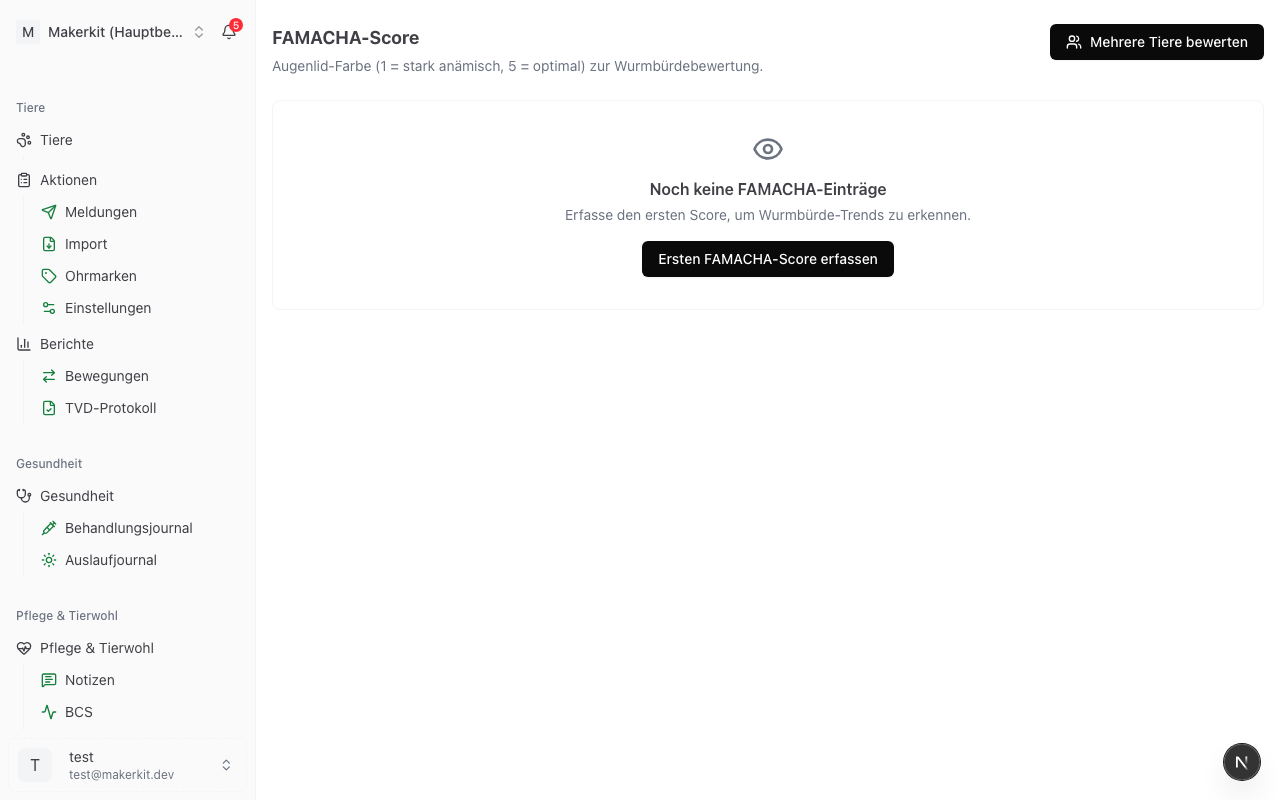
Note: The FAMACHA entry only appears if your herd contains sheep or goats. The animal list in the recording form likewise shows sheep and goats only.
The scale
The scale runs from 1 to 5. A deep red is good, white is critical. The higher the number, the paler the eyelid and the more pronounced the anaemia.
| Value | Colour of the eyelid | Meaning in Herdy |
|---|---|---|
| 1 | Deep red | Optimal |
| 2 | Red to pink-red | Good |
| 3 | Pink | Borderline |
| 4 | Pale pink | Anaemic |
| 5 | Almost white | Severely anaemic |
From value 4 upwards an animal counts as critical in Herdy and is listed as a treatment candidate. The recording buttons are coloured in the same shades as the scale, so that you can compare directly at the animal.
The overview page
Under Care & Welfare > FAMACHA the most recently recorded value with its date is shown for every animal that has been scored. A click opens the animal profile on the FAMACHA tab.
If there are animals with value 4 or 5, the Deworm X anaemic button also appears at the top. It opens the group treatment in the health module with exactly these animals and the category "Antiparasitic (deworming)" preselected. More on this under Recording treatments.
Recording values
FAMACHA is always entered via the multiple recording, even if you score only one animal:
- Go to Care & Welfare > FAMACHA
- Tap Score multiple animals
- Narrow down the list, using the search field, the species buttons or Select all
- Tick the box next to the animal. The five colour buttons appear underneath.
- Tap the value that matches the eyelid and move on to the next animal
- Tap Save all
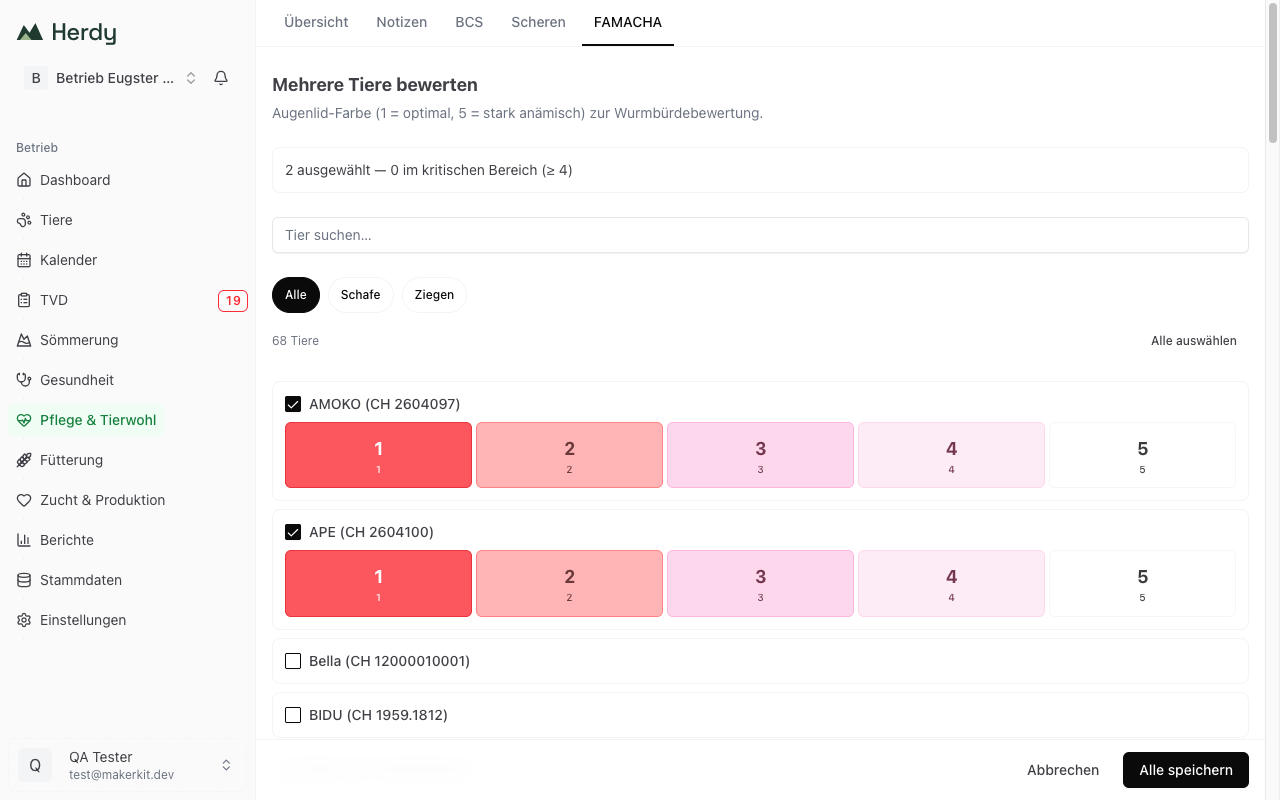
At the top a running count shows how many animals are selected and how many of them lie in the critical range from 4 upwards. All values are saved with today's date.
You reach the same recording from the animal profile via the FAMACHA tab and the Score multiple animals button.
Trend on the animal profile
The FAMACHA tab on the animal profile shows:
- a curve of all previous values of the animal
- a highlighted band for the treatment range from 4 upwards
- underneath, the list of all values with date, newest first
FAMACHA on the welfare dashboard
The FAMACHA distribution card on the care overview shows as a bar chart how many animals sit at which level, plus the number of animals in the critical range and the number of animals checked. The bars carry the colours of the scale, from green at 1 to red at 5.
How often to check?
The worm burden fluctuates with the grazing season:
- Spring: first increases when the animals go out to pasture
- Late summer: usually the peak, especially in wet weather
- Autumn and winter: the values normally go down
In the main grazing season a check every one to two weeks is usual, always on the same animal group, so that the trend stays comparable.
Background
The FAMACHA method comes from South African sheep farming and is recognised internationally today as a basis for selective deworming. It replaces neither a faecal sample nor a veterinary diagnosis, but helps to find the animals that really need a treatment. For a reliable assessment you need the official colour card at the animal; the colours on the screen are a memory aid, not a comparison standard.